


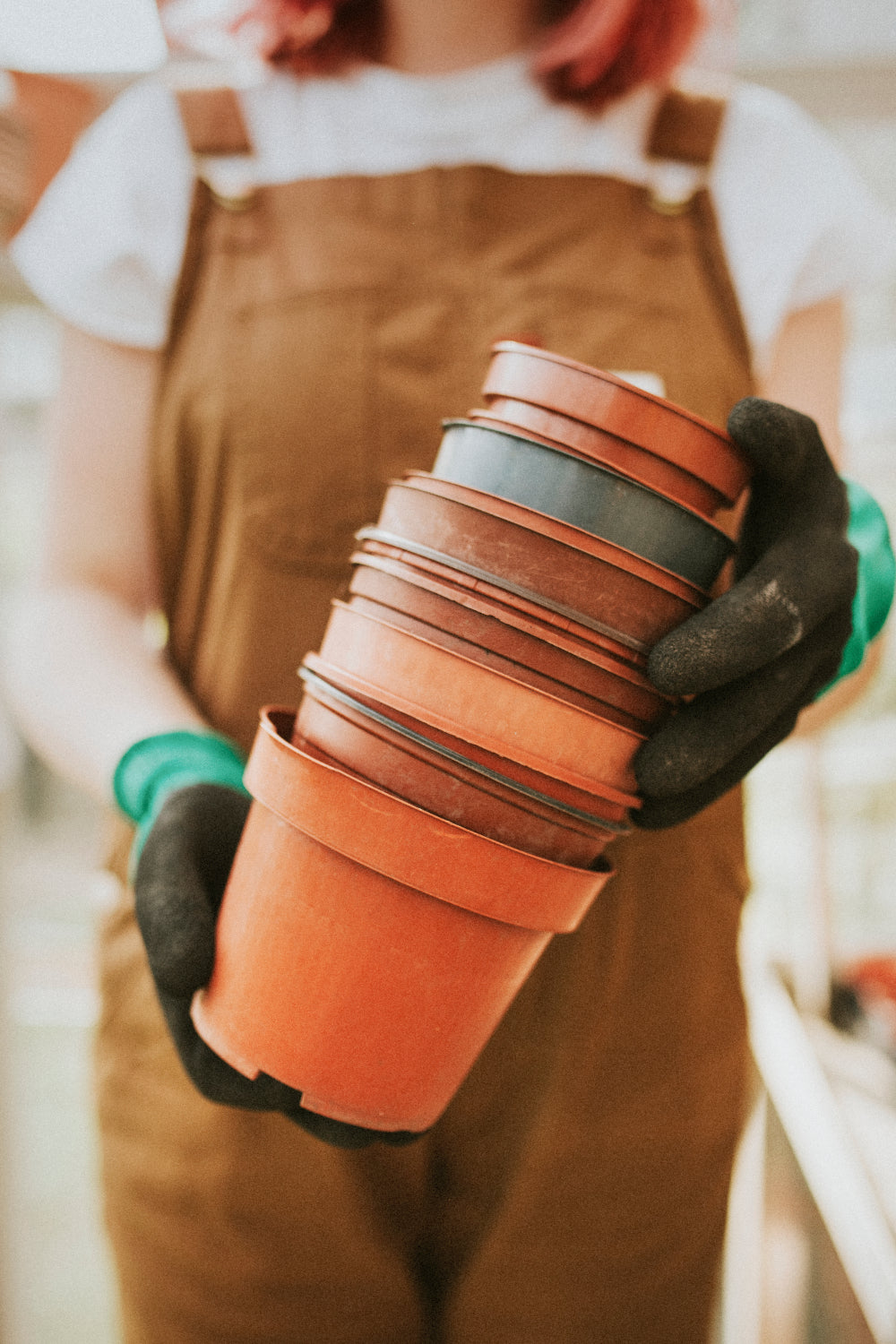
When buying plants or containers, nursery codes such as C2, C10 or P9 can be confusing. Understanding what a code refers to helps you compare plants, estimate growing-medium requirements and choose a decorative pot that will fit.
Understanding nursery pot codes
C codes: container volume
In nursery listings, the letter C commonly identifies a container by its nominal volume in litres. For example, C10 indicates a 10-litre container and C20 a 20-litre container. These codes are useful when comparing the supplied rootball and planning a larger planting scheme.
Nursery containers are often made from lightweight plastic and supplied with drainage holes. Round and square designs both exist. The volume code does not, on its own, tell you the pot's exact diameter, height or shape.
- Use the stated volume to understand the size of the container supplied with the plant.
- Check actual dimensions when fitting a nursery pot inside a decorative planter.
- Allow for the plant and its rootball when estimating how much additional growing medium is needed.
P codes: nominal pot dimensions
Codes such as P9 commonly refer to a small nursery pot with a nominal dimension of about 9 cm. Young plants, compact perennials and propagation plants are often sold in small pots of this kind. Check the supplier's dimensions to establish the precise width or diameter, height and shape.
Do not treat a P code as a fixed volume or assume it gives the width at the bottom of the pot. Different pot designs can have different capacities even when their stated width is similar.
At-a-glance comparison
| Code type | Information it usually gives | What to check separately |
|---|---|---|
| C, for example C10 | Nominal container volume in litres | Actual diameter or width, height and shape |
| P, for example P9 | A nominal pot dimension in centimetres | Exact dimensions, shape and capacity |
Why litres cannot be converted into one fixed diameter
A tall, narrow container and a low, wide one can hold the same volume. A list of litre capacities therefore cannot provide a universal diameter for every nursery pot. Use the dimensions on the specific plant or container listing whenever an accurate fit matters.
| Example code | Nominal volume | Fit inside a decorative pot |
|---|---|---|
| C1 | 1 litre | Check the supplied pot's dimensions |
| C2 | 2 litres | Check the supplied pot's dimensions |
| C3 | 3 litres | Check the supplied pot's dimensions |
| C5 | 5 litres | Check the supplied pot's dimensions |
| C10 | 10 litres | Check the supplied pot's dimensions |
| C20 | 20 litres | Check the supplied pot's dimensions |
| C50 | 50 litres | Check the supplied pot's dimensions and lifting requirements |
| C100 | 100 litres | Check the supplied pot's dimensions and lifting requirements |
Choosing a pot material
Compare our pots, tubs and planters, checking the internal dimensions and intended use of each model.
Plastic nursery pots
Plastic is light and can help retain moisture. A nursery pot with drainage holes is useful on its own or as an inner pot inside a decorative container. Check that the holes are open and that surplus water can leave the pot.
Terracotta pots
Unglazed terracotta allows moisture to evaporate through its walls. It is usually heavier than a comparable plastic pot, which can help with stability but also makes handling more demanding. Adjust watering to the plant, the material and the conditions.
Drainage and decorative outer pots
Give excess water a way out
For conventional planting in potting compost, drainage holes allow surplus water to escape. Keep them clear and choose a growing medium suited to the plant. A layer of gravel, broken pottery or clay balls is not a substitute for drainage holes and does not, by itself, solve excess moisture.
A small piece of broken pot can cover a very large drainage opening to reduce compost loss, provided water can still pass through. There is no need to fill the bottom with a thick layer for this purpose.
Using a decorative outer pot
Place the plant in a draining inner pot that fits inside the decorative container. When practical, remove the inner pot for watering, allow it to drain and then return it. Empty collected water so the rootball is not left sitting in it.
Check the outer pot's internal opening as well as its depth. Its external diameter may not describe the space available inside. A water reservoir or another specialist planting system should be used according to its own instructions.
Think ahead to repotting
A container with an opening narrower than its widest internal section can make removing an established rootball difficult. A removable inner pot can help when you want to use an unusual decorative shape. Plan how the plant will be watered, lifted and repotted before installation.
How much larger should the next pot be?
Use the current rootball and the plant's growth as your guide. Move into a modestly larger pot when needed instead of making a large jump in size. Excess compost around a small rootball can remain wet for too long, making watering harder to manage.
For smaller containers, an increase of a few centimetres in width is often sufficient. There is no single multiplier that suits every species, pot shape and growing environment.
Fast-growing plants
Check root development regularly and provide additional space as the plant needs it. Fast growth does not mean the plant should automatically be moved into a container one and a half times the width of its rootball.
Plants with large foliage
Consider stability as well as root space. A suitable outer planter can add weight or support without placing the roots in an unnecessarily large volume of wet compost. For outdoor positions, take wind exposure and the planted weight into account.
Palms
Choose dimensions suited to the species and the existing rootball. Check both depth and width, and ensure that the container can support the plant securely. A tall decorative pot does not automatically provide the right growing conditions for every palm.
Cacti and succulents
Match the pot to the individual plant's root system rather than assuming that every cactus or succulent needs a shallow container. Pay particular attention to drainage, the growing medium and watering conditions.
In summary
The pot code helps describe the supplied format, while the actual dimensions determine whether it fits a decorative container. When repotting, match the growing space to the rootball and plan both water drainage and the stability of the finished arrangement.
NATURA tips
- Identify whether the size shown is a volume, a diameter or an external dimension.
- Measure the nursery pot or rootball and the decorative pot's usable opening.
- Plan drainage and the removal of surplus water.
- Choose a manageable increase in growing space, with enough stability for the plant.
- Check the planted weight and how you will access the plant for care and repotting.
Unsure which of two containers to choose? Contact NATURA with the nursery pot’s dimensions, the plant and its intended position.